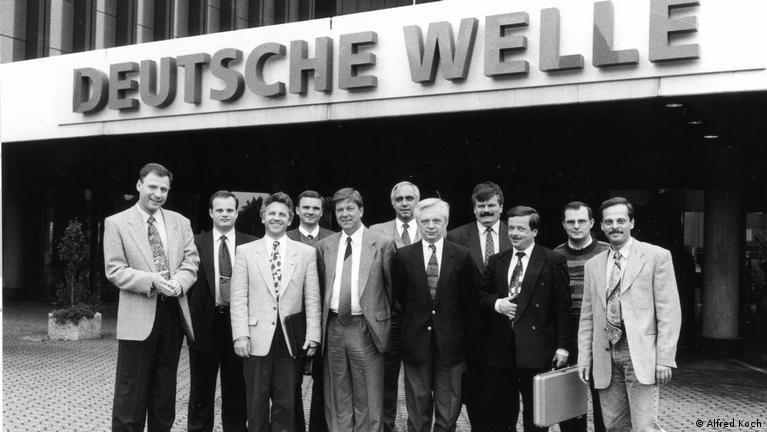
60 years ago, DW launched eight new languages

"60 years after their founding DW offerings are more important than ever for the people in Central and Southeastern Europe. We offer unbiased and reliable information to people living in countries where the media are being increasingly regulated by the state and they are continually made to feel insecure by targeted disinformation and fake news. This way, we are helping the people there to orient themselves," says Adelheid Feilcke, Director of Programs for Europe, about the eventful history and significance of the current offering of ten European languages.
60 years of DW Polish: "The voice of peace and of reconciliation from Germany"
When editor Andreas Krause talks about the most emotional moment during his time at DW Polish, his voice shakes a little. The 76-year-old remembers: "In 1994, former Polish forced laborers came into our offices. They told us 'We are so thankful, that you were the voice of peace and of reconciliation from Germany'." Krause was in high school in 1962 in the Upper Silesian city of Gliwice, when he first heard a DW show in Polish via short wave. He was so happy that a West German broadcaster joined Radio Free Europe and the BBC in producing radio formats for Poland.

The first editors for DW Polish came from a broad range of fields. Service Head Maritta Weber and her deputy, Alexander Borski, were the only professional radio journalists. Before World War II, Borski was a writer for Radio Lwów (today Lviv in Ukraine). Some of the other employees were refugees from Poland with German roots.
"Very turbulent times"
The offering in Polish was expanded systematically. In 1962, DW was producing 30 minutes a day, in the 1970s, they were doing two hours. These were eventful times for German-Polish relations. German Chancellor Willy Brandt signed a series of treaties and recognized the Oder-Neisse Line as the border between the two countries.
This led to a conflict in the service: While the editors supported the federal government's policies, the Head of the main department, Botho Kirsch, himself a refugee, was strictly against it. "The government found a way out of this dilemma," recalls Andreas Krause. In 1977, the Polish service was moved from DW and integrated into Deutschlandfunk (DLF), which had been broadcasting in Polish since 1963. "Deutschlandfunk had a different philosophy," remembers Krause. "DLF was less anti-communist and reported less about Poland, but rather more about Germany."
New signs of understanding
Another programming reform in 1993 saw DW take over the DLF Polish service. The fall of the Iron Curtain made new forms of cooperation possible, enabling the first-ever contact with Polish media.
The first cooperation with a Polish TV station was kicked-off in 1999. DW Polish enjoys high usage via online partnerships (around 80 percent of user activity). According to Marketing and Audience Insights (MAI), they had an average of 16.6 million clicks from January to June 2022.

On the occasion of its anniversary, the team also remembers former employees. DW programs were significant and at the same time uncomfortable for the communist regime in Poland, "The intelligence service had at least one agent in our team. Their archives have thousands of pages of reports about internal matters from within the team in their archives," says Bartosz Dudek, Head of Programs for Europe/Polish Service since 2009.
The worst Dudek found in the documents was an official memorandum about a woman in Poland who was sentenced to two years in prison for listening to DW.
Bartosz Dudek: "Poland and Germany have been partners in NATO and in the EU for years. Nonetheless, time and again, differing points of view on historic and current topics are a cause for annoyance and misunderstanding between the two neighbors. DW Polish has informed its users for 60 years, explains political events and puts them into context. This role makes the DW offering from Germany an important bridge in the bilateral relationship with Poland."
60 years in Southeastern Europe: Almost an anniversary for DW Magyar
The Hungarian service has had an interesting journey. From 1962 until its closure in 1977, the service focused solely on radio broadcasts. DW reopened it in 1993 for another six years and then again in April 2021. This time focusing on journalistic content for a target audience between the ages of 20 and 35.
Director General Peter Limbourg said in April 2021 "Now is the time for DW Magyar. Many media in Central and Eastern Europe that have reported critically on their governments are facing various obstacles to their work or have had to give up. With our programming, we are responding to the growing demand for information among the general public, as well as to the increasing restrictions on media freedom and the risks faced by journalists around the world." DW Magyar hit the ground running when it launched in 2021 with 15 videos and reports on a YouTube channel including episodes of the formats Europeo and Untold Stories.

In the face of the war in neighboring Ukraine and the increasing restrictions placed of freedom of the press in Hungary, DW recently added aFacebook page to its offering there, bringing their content to the country's most popular social media platform. With the new Facebook page, DW is addressing the need for information of young, politically-interested Hungarians who no longer see their views represented in national media. There is also a high degree of interest in videos about the war in Ukraine.
"The many restrictions placed on media in Hungary and the war happening right in their own neighborhood are moving us to strengthen the influence of liberal discourse and of plurality on how Hungarians form their opinions," says Dóra Diseri, Head of DW Magyar. To produce the magazine show Europeo, the service cooperates with TV partner ATV, the only independent news channel left in Hungary.
60 years DW Serbian and Croatian: Media bringing ethnic groups together
60 years after launching with radio shows in many of the languages spoken in Eastern and Southeastern Europe, DW has considerably build up its offering to the target region.
Today, five services offer information in the languages of the former Yugoslavia via the Internet. Croatian and Serbian were the first two to launch in 1962. Slovenian, which went live on short wave a little later was shut down in 2000. DW has broadcast in Macedonian since 1980; they are still a stand-alone service. Czech and Slovak, which also went live in 1962 with radio content, were shut down in the mid-1990s due to major decreases in usage.
Bosnian and Albanian were added as DW languages in the 1990s following the break-up of Yugoslavia. The Wars in the Balkans also led to temporary tensions among the services – a real balancing act for DW managers at the time.
Today, roughly 30 years after the end of the wars, Serbian, Croatian and Bosnian colleagues work together in one editorial team. Despite the differences in how they see the past and the present, they have a strong sense of cohesion. "We know and appreciate each other and discuss differences of opinion in a professional manner," says Volker Wagener, Head of Programs for Europe/Bosnian, Croatian and Serbian Service. Their benchmark is the DW mission, "which we all stand behind".
60 years of French for Africa: Focusing on young target audiences
French for Africa started in 1962 with a daily five-minute news radio broadcast. Today, the multimedia service reaches an increasing number of young people well outside of the West African target market.
DW is as important to him as the bread he eats each day – Kinshasa-based business man Valérie Luzingu recently paid the French for Africa service this compliment. In his line of work, he needs to keep well-informed about the world and for that, he uses their offerings.
The program goes out to around 20 francophone countries. Beyond that, listeners and users in other regions can listen to the shows and use the social media channels. With 10 million weekly users, French is ranked sixth among the most-used languages at DW.
The editors experience something new every day: Recent military coups in four francophone countries on the continent, for instance. The majority of the people in Mali agree with the course laid out by the military regime. Situations like this one call for a high degree of journalistic finesse and discussions in the service to transmit DW values without losing users. Luckily for them, the 20 employees in Bonn come from 14 countries, speak a broad range of African languages and all bring varying points of view to the table.

The team has a good network of correspondents in Africa as well as from a number of countries outside Africa to support them. This work is especially dangerous for those on the ground in times of upheaval or when a coup begins: direct phone calls from government representatives, anonymous threats or shitstorms in social media – there are too many methods for intimidation to list. But the strong reputation enjoyed by DW also helps protect the colleagues.
"DW is highly recognized and gets a lot of positive feedback from French-speaking markets in Africa," says Claus Stäcker, Director of Programs for Africa. "For the last 60 years, our radio program has delivered reliable and credible information through many crises. Our audience values Germany's voice as being unbiased, moderate and constructive."
Currently, many formats primarily target a younger audience: Nous, les 77 Pour cent or #PasSansElles by youth reporters. Sevan Ibrahim-Sauer, Head of Distribution Africa, also knows how important these formats are: "The last six incredible decades have seen DW become deeply rooted in the region, thanks to its ability to change. From the Voix d'Allemagne to DW Afrique – a good way to go. We would also like to congratulate the service in the name of our 200 partners!"